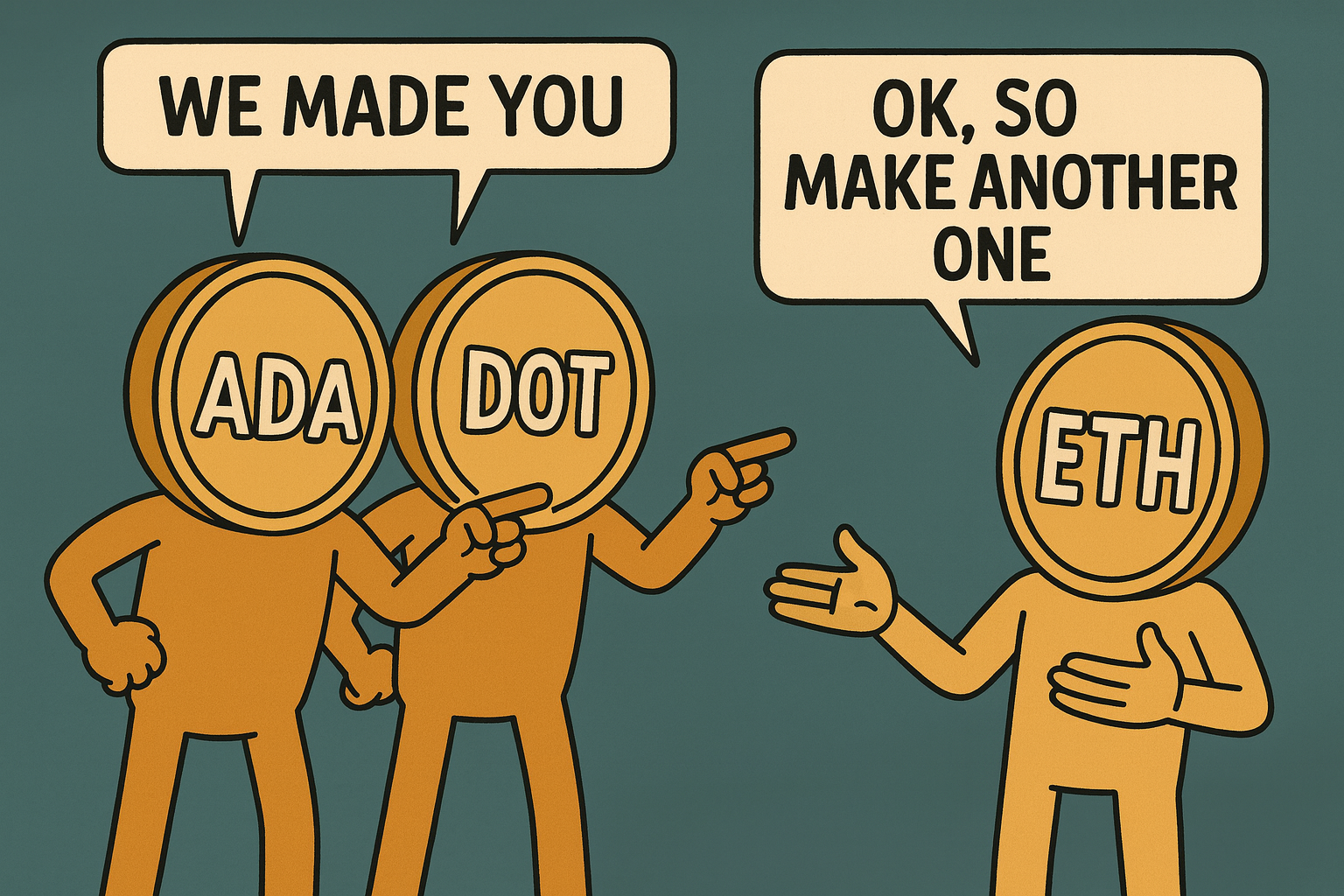
When Jay-Z told Dame Dash, “You said you made Hov well, make another one,”
he wasn’t just throwing shade he was defining greatness.
It’s one thing to build a legend once. It’s another to do it twice.
And that’s exactly the challenge Charles Hoskinson and Gavin Wood set themselves when they walked away from Ethereum the chain they helped create to “make another one.”
Nearly a decade later, the results speak louder than ambition.
Ethereum still stands as crypto’s unstoppable engine while its prodigal sons are stuck trying to recreate its spark.
The Founders Who Left the Empire
Both men were at the genesis of Ethereum.
Charles Hoskinson, a co-founder, left after ideological rifts with Vitalik Buterin and went on to build Cardano (ADA) a project obsessed with academic purity, peer review, and theoretical perfection.
Gavin Wood, Ethereum’s first CTO and the man who wrote Solidity, broke away to form Polkadot (DOT) and its experimental twin, Kusama (KSM) promising a web of interoperable blockchains that would make Ethereum obsolete.
They had the talent. They had the funding. They had the spotlight.
But when the dust settled only one chain still carried momentum Ethereum.
Kusama: The Intelligent Rug
In 2021, KSM was the golden ticket.
It soared beyond $500 marketed as the proving ground for Polkadot’s grand design.
Investors were encouraged to lock their KSM in parachain auctions, funding new projects and earning token rewards.
The mechanism looked brilliant on paper decentralised crowdfunding for the next wave of innovation.
Then came the catch.
Those KSM tokens were locked for up to two years.
No exit. No liquidity.
While holders waited, KSM’s price collapsed from $500 to $10, wiping out over 98% of value.
The locked funds couldn’t move, couldn’t hedge, couldn’t breathe.
By the time the coins were finally unlocked, the ecosystem they helped fund from Akala to Moonriver had shriveled.
Parachain rewards turned worthless, liquidity drained, and enthusiasm evaporated.
Cardano: The Perfection That Never Shipped
Hoskinson’s Cardano promised a “scientific” blockchain every step peer-reviewed, every upgrade delayed until mathematically verified.
It was supposed to outgrow Ethereum’s chaos.
Instead, Cardano drowned in its own bureaucracy.
Years later, ADA trades far below its highs, and its decentralized app ecosystem remains thin compared to Ethereum, Solana, or Base.
Smart contracts exist but where’s the traction?
Cardano became the academic’s blockchain: beautiful in theory rarely used in practice.
Polkadot: The Web3 That Never Webbed
Gavin Wood’s vision for Polkadot was grand an internet of blockchains, seamlessly connected, scalable, and secure.
But the technology proved too complex, too slow, and too confusing for most developers.
After years of hype, DOT sits under $5, a shadow of its former glory.
The promise of parachains delivered more lock-ups than breakthroughs.
Ethereum Keeps Doing What It Always Did Win
While its children struggled, Ethereum kept evolving.
It faced every storm high gas fees, market crashes, environmental criticism and came out stronger each time.
Here’s what “winning” looks like in data, not talk:
✅ The Merge (2022): Ethereum transitioned from Proof-of-Work to Proof-of-Stake, cutting energy use by over 99% the largest sustainability leap in blockchain history.
⚡ Layer-2 Explosion: Networks like Arbitrum, Optimism, Base, and zkSync now process more transactions than Ethereum’s mainnet yet all settle back to ETH expanding its reach rather than replacing it.
💰 DeFi Dominance: Over 60% of total DeFi value (TVL) still lives on Ethereum-based platforms from Uniswap to Aave to Lido.
🎨 NFTs and Culture: Ethereum remains the cultural backbone of NFTs, powering OpenSea, Blur, and countless digital art movements.
🧱 Resilience Through Bear Markets: ETH’s market cap rebounded above $500 billion, surviving multiple crypto winters proof that innovation, not imitation, keeps value alive.
🧠 Continuous Innovation: Sharding, proto-danksharding, and rollup scaling solutions keep pushing throughput and efficiency forward not empty whitepapers, but live code in production.
Ethereum is no longer a startup experiment.
It’s digital infrastructure the bloodstream of Web3.
And it’s still growing while others fade into their own complexity.
The Verdict
Charles and Gavin walked away from the table thinking they could build another masterpiece.
They had the same blueprint, the same brilliance but they forgot that Ethereum wasn’t just code.
It was timing, community, grit, and relentless evolution.
Kusama’s $500 dreams now rest at $10.
Cardano’s peer-reviewed perfection still waits for its audience.
Polkadot’s web of chains tangled itself into irrelevance.
Meanwhile, Ethereum the one they left just keeps building, expanding, and redefining what crypto means.