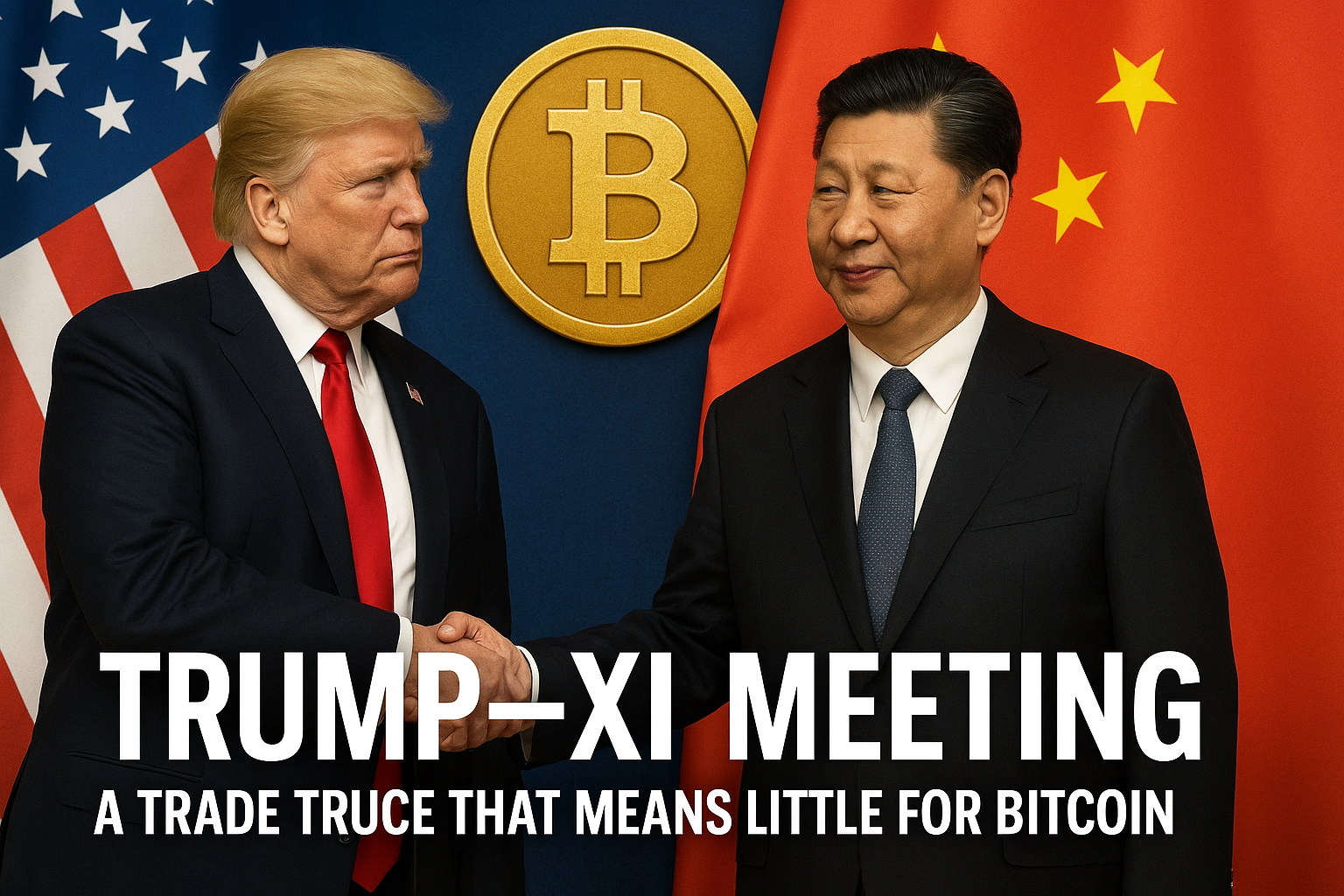
Donald Trump’s much-hyped meeting with Chinese President Xi Jinping in Busan produced what markets politely call “constructive dialogue” a modest tariff rollback and some temporary trade concessions. But beneath the diplomatic smiles, the power asymmetry was hard to miss: Xi arrived with leverage; Trump arrived with a need. The result was not a structural breakthrough in U.S.–China relations, but a political pause and for Bitcoin, that means little more than background noise.
The headlines sound grand: tariffs on select Chinese goods trimmed from roughly 57 % to 47 %, a one-year suspension of China’s rare-earth export controls, and renewed promises on fentanyl enforcement. Yet the details reveal fragility. All major Chinese concessions are reversible; none alter Beijing’s industrial policy or capital-control regime. Trump, meanwhile, offered immediate and tangible relief to importers a move that soothes short-term inflation and buys him breathing space ahead of the 2026 midterms. The optics matter more to him than the economics.
For global markets, that translates into a fleeting “risk-on” sentiment equities tick higher, yields soften slightly, and traders briefly exhale. Bitcoin, however, is governed by a different gravity. Its macro correlation to stocks exists, but the deeper forces driving crypto liquidity remain tied to U.S. monetary policy, dollar strength, and regional capital flight dynamics. The Busan handshake doesn’t touch any of those levers.
If anything, a mild U.S. China détente slightly strengthens the yuan and eases capital-flight anxiety historically a bearish nuance for BTC, which thrives when Chinese wealth seeks offshore hedges. No signals emerged of Beijing relaxing its domestic crypto bans, reopening exchanges, or unblocking mining operations. The one-year rare-earth reprieve may marginally help ASIC hardware logistics, but that’s a rounding error for network economics.
Trump’s “12 out of 10” enthusiasm is characteristic: rhetorical triumph over structural change. The meeting reduces noise but creates no new liquidity engine for digital assets. Unless the tariff relief triggers a meaningful disinflation pulse that hastens Federal Reserve rate cuts, Bitcoin remains anchored to broader risk cycles rather than geopolitics.
In short, the Busan summit is a headline for politicians, not a catalyst for Bitcoin. It neutralizes a small tail-risk but fails to unlock new demand or capital flow. Crypto’s real pivot points still lie elsewhere in central-bank liquidity, regulatory evolution, and the global search for yield. The Trump-Xi handshake may calm markets for a week; Bitcoin will keep moving to its own rhythm, unimpressed by the theater of diplomacy.