
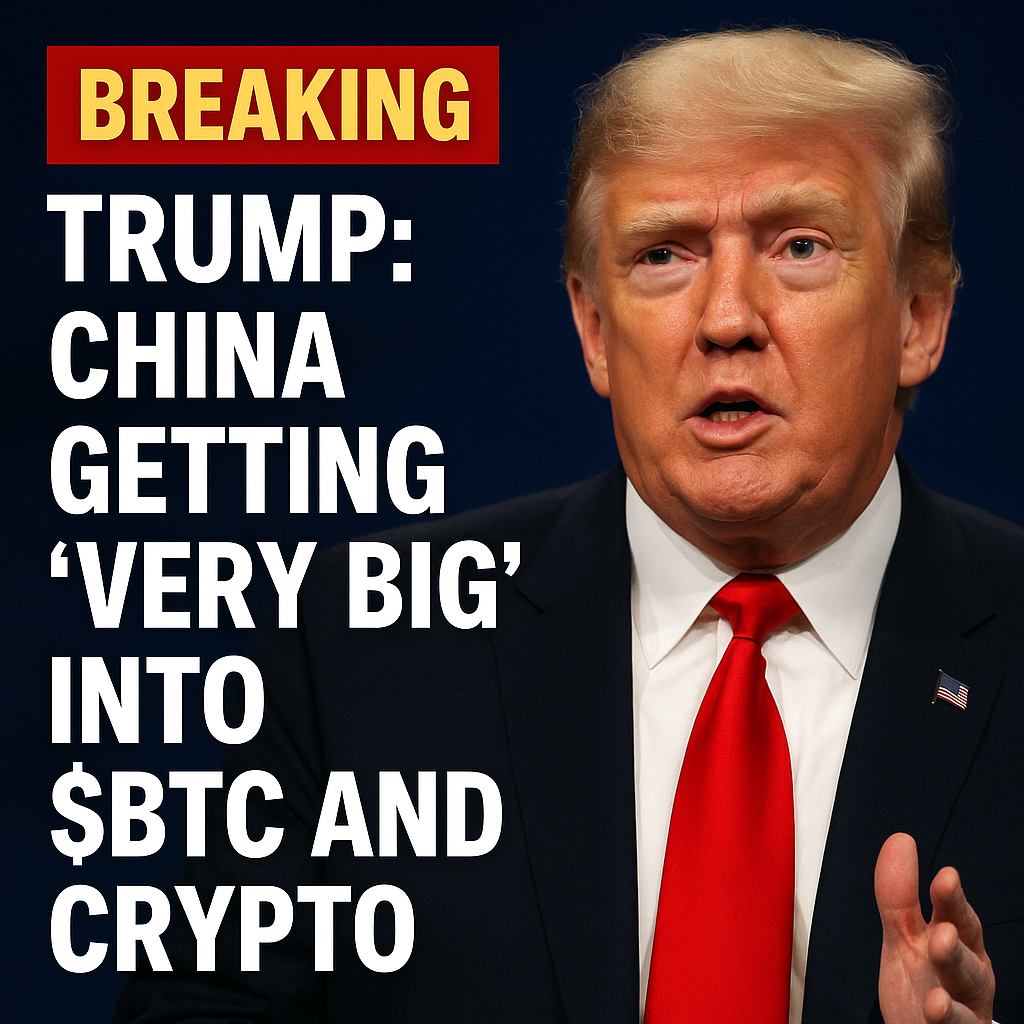
Former President Donald Trump recently claimed that China is “getting very big into” Bitcoin and other cryptocurrencies, a statement that has drawn both attention and skepticism from market analysts. Speaking at a conference in mid-2024, Trump warned that if the United States does not embrace digital asset innovation, China and other nations could take the lead. According to Reuters, he stated that the U.S. must not allow China to dominate the future of cryptocurrency, pledging to establish a national Bitcoin stockpile if reelected.
The comment, while verifiable as a statement made by Trump, is not directly supported by evidence that China has significantly increased its official involvement in crypto. Beijing still maintains strict bans on retail trading and a heavy regulatory stance toward private mining operations. Reports from Reuters and Bloomberg indicate that the Chinese government continues to favor its central bank digital currency, the digital yuan, as its preferred form of digital finance rather than decentralized assets such as Bitcoin or Ethereum.
Analysts view Trump’s statement as more of a political posture than an observation rooted in data. It aligns with his broader theme of economic competition with China, using cryptocurrency as the latest frontier in that rivalry. The U.S. crypto industry has become increasingly sensitive to such rhetoric, especially as recent tariff escalations and trade tensions between Washington and Beijing have triggered volatility across digital assets. In mid-October 2025, for instance, Bitcoin and Ethereum fell sharply after Trump announced new 100 percent tariffs on Chinese imports, wiping billions off the market within hours.
There is, however, an indirect truth to the claim. Despite the formal bans, underground mining and over-the-counter trading activity remain significant in parts of China, with research suggesting that some Chinese entities still contribute to global Bitcoin hash power through offshore operations. Yet these developments are largely informal and far from the coordinated state-level investment that Trump’s wording might imply.
In essence, Trump did say China is getting “very big” into Bitcoin and crypto, but the substance of that statement remains largely rhetorical. The available evidence shows that China’s government remains cautious, focusing on its own digital yuan rather than embracing decentralized cryptocurrencies. The claim therefore reflects political positioning rather than a verified shift in Chinese crypto policy.