
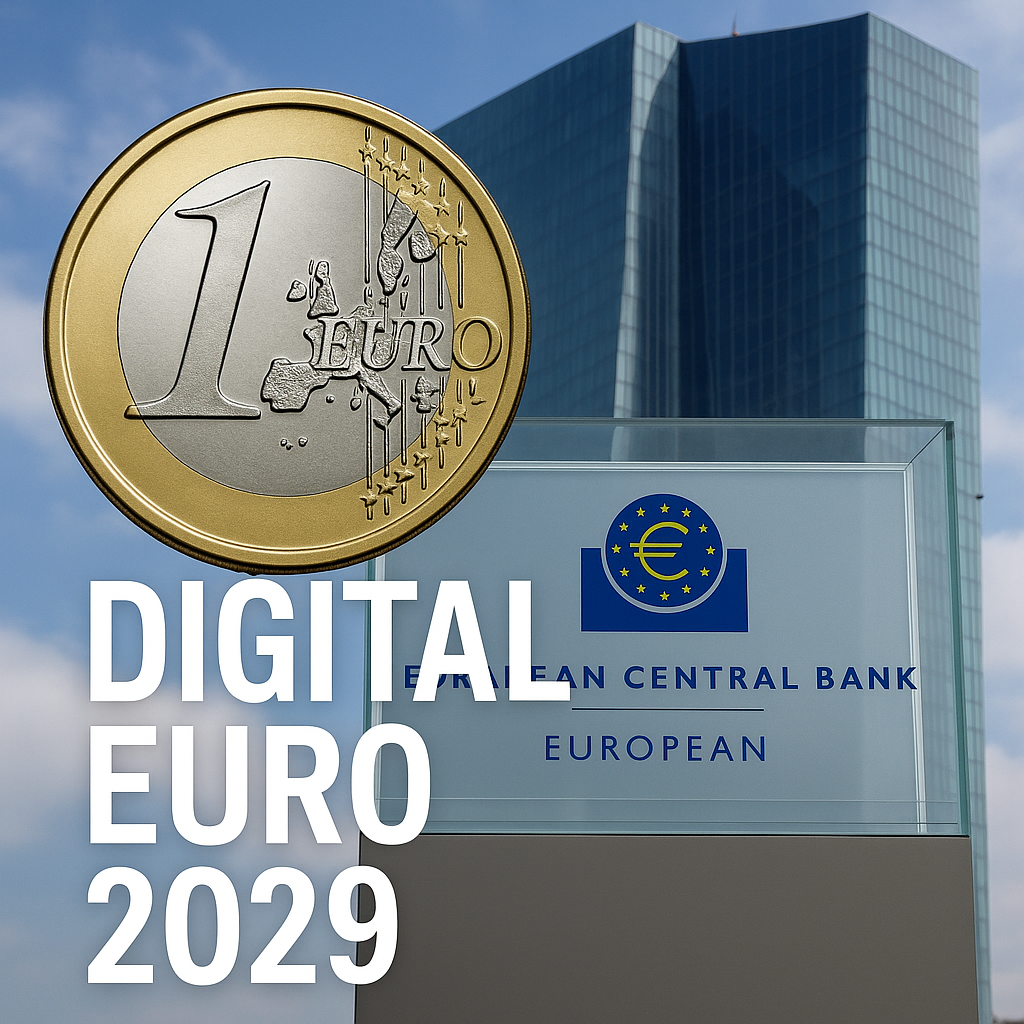
The European Central Bank (ECB) has officially advanced its long-running digital euro project into a new phase, marking a significant step toward introducing a central-bank digital currency (CBDC) within the next four years.
In an announcement on October 30, the ECB’s Governing Council confirmed that the 24-month preparation phase launched in November 2023 has concluded, paving the way for work focused on technical readiness, market engagement, and legislative support.
The next stage aims to develop the digital euro’s core infrastructure, refine its rulebook, and work closely with payment providers, merchants, and consumer groups to prepare for pilot testing. The ECB will also provide technical expertise to the European Parliament and Council, which are currently debating the proposed legal framework needed for the project to proceed.
Pilot in 2027, Readiness by 2029
According to the ECB’s newly released progress report, the institution now plans to begin a limited pilot of the digital euro as early as mid-2027, provided EU lawmakers pass the necessary legislation in 2026. Full operational readiness and the possibility of the first issuance is targeted for 2029. While some commentators described this as a “four-year countdown,” the ECB stresses that no final decision on issuance has been made. “We will only move forward once the legal foundation is in place and the system is technically sound,” the report states.
Costs and Infrastructure
For the first time, the ECB disclosed cost projections: about €1.3 billion in development costs through 2029, followed by €320 million per year in operating costs. Officials noted that those figures are comparable to the expense of producing and managing banknotes and should be offset by seigniorage revenues.
Technology partners have already been selected to build parts of the infrastructure. German security technology firm Giesecke+Devrient, along with Nexi and Capgemini, will lead development of the offline payment feature a critical component for ensuring the digital euro can function even without network access, mirroring the resilience of cash.
Privacy and Design Choices
ECB Executive Board member Piero Cipollone said the project’s design centers on “cash-like” privacy, with no centralized database of user transactions and no “programmability” that would restrict spending. The digital euro will bear no interest and may include a holding limit estimated at around €3,000 per person to prevent destabilizing deposit outflows from banks.
Public and Market Response
Surveys show strong initial interest: roughly two-thirds of Europeans said they would try a digital euro if it offered privacy, simplicity, and reliability. Small merchants have also expressed support, citing potential relief from high card-processing fees charged by private networks such as Visa and Mastercard.
Still, privacy advocates and some banking groups remain cautious, warning of risks from deposit flight and digital surveillance.
‘Future-Proofing the Euro’
ECB President Christine Lagarde defended the project against critics who called it “a solution in search of a problem.” She described the digital euro as essential to preserving Europe’s monetary sovereignty. “Money must remain a public good, accessible to all citizens including in the digital age,” she said.
The ECB insists the digital euro will complement, notreplace, cash. In parallel, Brussels is advancing separate legislation to safeguard Europeans’ right to pay with physical money ensuring both forms of the euro coexist in the years ahead.