One man’s experience of being shut out of the financial system in plain sight — and what it reveals about the most terrifying and exciting wealth transfer in human history
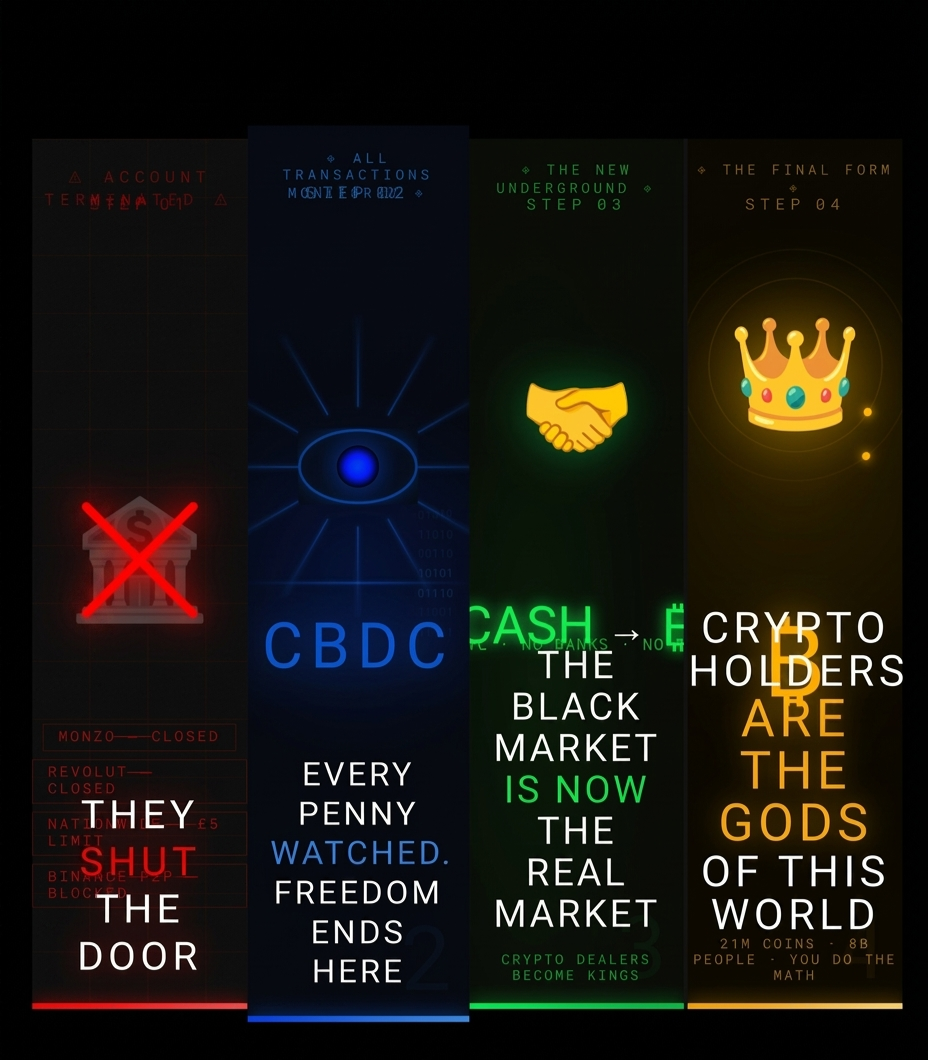
It started with Monzo.
I wasn’t doing anything illegal. I wasn’t funding terrorism, laundering money, or running any kind of scheme. I was a regular person in the United Kingdom trying to buy cryptocurrency — a completely legal activity — using my own money that I had earned, saved, and deposited into an account with my name on it.
They closed it. No meaningful explanation. No appeal process. No human being to speak to. Just a notification, a closed door, and silence.
Fine. I moved to Revolut.
Revolut is supposed to be the future of banking. Digital-first. Built for the modern world. The kind of fintech product that runs ads about freedom and flexibility and being different from the old institutions.
They debanked me too. Same reason. Same process. Same silence.
Two accounts. Two closures. Both for doing something completely legal. Both without due process, without explanation, without recourse.
So I went to Nationwide. Traditional. Established. Surely a high street bank with decades of history wouldn’t pull the same stunt.
Nationwide didn’t close my account. What they did was arguably more insulting. I had a verified crypto purchase limit of £5,000. A reasonable amount for someone who takes their financial future seriously. Without warning, without a letter, without a phone call, that limit was quietly revised.
To £5.
Five pounds. The price of a meal deal. On a limit that had been five thousand pounds. A reduction of 99.9% dressed up as an administrative update, clearly designed to make crypto purchasing functionally impossible without having to say out loud that they were making it functionally impossible.
At this point I turned to peer-to-peer. Binance P2P — a system that allowed ordinary people to buy crypto directly from other individuals, bypassing the banking gatekeepers entirely. The last legitimate workaround standing.
Binance shut down P2P for UK consumers.
I want you to sit with that for a moment. Every door, closed. Every route, blocked. Every workaround, eliminated. All of it happening quietly, incrementally, with no fanfare and no accountability — to a person doing nothing wrong, in a country that legally permits everything I was trying to do.
I had to devise my own model. I had to think and move like someone operating outside a system that had decided, without ever saying so directly, that I was no longer welcome inside it.
And in doing that — in being forced out of every official channel — I saw something that most people haven’t seen yet.
I saw what is coming. And it is going to turn the entire financial world upside down.
UNDERSTAND WHAT THEY ARE BUILDING AROUND YOU
This wasn’t bad luck. This wasn’t a series of unrelated compliance decisions made independently by separate institutions.
This is a coordinated direction of travel. And it has a destination.
Right now, governments across the Western world are racing to roll out Central Bank Digital Currencies — CBDCs. State-issued digital money that replaces physical cash and connects every single transaction you make to a digital identity with your name, your face, your address, and your history attached to it.
Every coffee. Every political donation. Every purchase. Every payment to every person. Logged. Analysed. Stored. And in the wrong circumstances — blocked, reversed, or used against you.
This is not speculation. This is published policy. Central banks are announcing it. Governments are consulting on it. The architecture is being built right now while most people are distracted by the theatre of daily life.
And in that world — in a world of total financial surveillance — cryptocurrency is the only exit door.
Not because crypto is perfect. Not because it has no volatility or complexity. But because it is the only monetary system in human history that is structurally outside their reach. Borderless. Permissionless. Unseizable without physical force. Capable of moving value across the world in seconds without asking anyone’s permission.
That exit door is exactly what they are trying to close. What I experienced — the debanking, the absurd limits, the P2P shutdown — was not about protecting consumers. It was about sealing the door before enough people get through it.
THE MOMENT THE LAST DOOR CLOSES
Here is where the story shifts from frightening to extraordinary.
Because the people trying to close that door are about to make the most catastrophic strategic error in the history of money.
When the last legitimate route into crypto closes — when every bank blocks it, every platform restricts it, every P2P market is shut down for ordinary consumers — something will happen that no government policy can prevent.
People will still want in.
Not a few people. Not the tech-savvy early adopters. Millions of ordinary people — people who watched crypto prices move, people who read articles like this one, people who finally understood what was happening and decided they needed to act — will wake up one day and discover that the door is locked.
They will go to their bank. Blocked.
They will go to an exchange. Restricted.
They will go to a P2P platform. Shut down.
And then they will do what desperate people have always done when a system fails them.
They will come looking for someone who already has it.
THE BEGGING IS COMING
I want you to imagine this scene — because it is not a fantasy. It is a logical conclusion of the trajectory already in motion.
A person — educated, professional, financially literate — sits across from someone who stacked Bitcoin quietly over the last few years. Maybe it’s a kitchen table. Maybe it’s a back room. Maybe it’s a car park at night.
And they say: I need to get money into crypto. I’ll pay whatever you want. Name your price.
This is not science fiction. This is prohibition. This is what happens every single time in human history when a government decides to criminalise or restrict access to something that large numbers of people desperately want.
The bootleggers don’t just survive. They become the most powerful people in the room.
And here is the economic reality that makes this unprecedented in scale:
When no new money can flow into crypto through legitimate channels — when the on-ramps are all closed, all blocked, all restricted to £5 limits and debanked accounts — something happens to the price of the coins already in circulation that most people haven’t fully thought through.
Zero inflow. But demand doesn’t disappear. It explodes.
People can still spend crypto. Merchants will accept it. International transfers will use it. The parallel economy will run on it. The use case — the fundamental reason people need it — will not shrink when the banks close the door.
It will be the only reason the banks ARE closing the door.
Supply locked. Demand accelerating. Every person who wants in, forced to find someone who already holds it and negotiate from a position of desperation.
What does that do to price?
What does that do to the power of the person sitting on the other side of that kitchen table?
THE MATHS OF GODHOOD
Let’s be clinical about this for a moment.
Bitcoin has a hard cap. 21 million coins. Ever. Not 21 million more next decade. 21 million total. For the entire planet. For all 8 billion people. For every government, every institution, every individual who will ever want a piece of it.
Right now, a significant portion of those coins are already lost — wallets whose owners died without passing on seed phrases, early coins burned or abandoned, Satoshi’s untouched billions sitting dormant. The real circulating supply is already far smaller than 21 million.
Now take that fixed, shrinking supply. Add the scenario unfolding in real time — banks blocking purchases, platforms restricting access, governments building surveillance money designed to replace everything else.
Now add the moment when people need crypto not as a speculative investment but as a functional necessity — because it is the only way to send money anonymously, the only way to transact outside government visibility, the only way to move wealth across a border without declaring it, the only way to buy things the CBDC system has decided you shouldn’t buy.
What is the price of the only key to a door that millions of people are desperately trying to walk through — when no new keys are being made and the existing keyholders have no obligation to sell?
There is no ceiling. There is no comparable historical precedent. There is no model that captures what happens when the scarcest asset in human history becomes simultaneously the most necessary asset in human history.
The current holders of Bitcoin, Ethereum, and major stablecoins are not just sitting on investments.
They are sitting on the infrastructure of human freedom in the surveillance age.
And infrastructure, when it becomes indispensable, does not get valued like a commodity. It gets valued like power itself.
THE BLACK MARKET BECOMES THE REAL MARKET
When the official channels close completely, the informal market doesn’t disappear. It professionalises.
Think about how cannabis operated for decades before legalisation. It wasn’t chaos. It was a functioning economy with its own supply chains, its own reputation systems, its own pricing mechanisms, its own version of brand trust. The people at the top of that economy didn’t live in fear. They lived in wealth and influence — because they controlled access to something people would not stop wanting no matter what the law said.
Crypto’s black market will be cleaner, faster, and more sophisticated than any black market in history — because the product is digital, weightless, and globally transferable in seconds.
Someone with a cold wallet and a reputation for honest dealing will become the most sought-after person in their community. People will come to them the way people once went to the money changers outside the city walls. The way people went to the gold dealers when currencies collapsed. The way people found the man who knew the man in every era where the official system failed the people it was supposed to serve.
They will go to these people with cash. With gold. With valuable goods. With services. With desperation. And the crypto holder will name their price — because they have no competition.
The freedom premium — the markup above market price that someone pays to get into crypto through unofficial channels — will not be 5%. It will not be 10%. In a world where there is genuinely no other way, the premium is whatever the holder decides it is.
And the holder will compound that advantage every single day that the official doors stay closed.
THESE ARE NOT JUST RICH PEOPLE. THESE ARE THE NEW UNTOUCHABLES.
Every ruling class in human history has derived its power from one thing: control over something everyone else needs.
Land. Water. Trade routes. Information. Energy. Capital.
The crypto sovereign of the near future controls something more fundamental than any of these.
They control the ability to transact freely in a world where free transaction has been made illegal for everyone else.
A man with £10 million in a British bank account cannot send money to a sanctioned country. Cannot donate to a cause the government has flagged. Cannot pay someone in cash above a certain amount. Cannot move his own money internationally without a compliance department approving it first. Cannot spend his own savings on certain categories of goods.
He is wealthy. He is utterly, completely dependent.
The person with £1 million in self-custodied Bitcoin can do all of those things before breakfast. No permission required. No compliance officer. No transaction monitoring. No bank to call and explain himself to.
His financial life operates on a completely different plane of existence.
And in a world where financial control is the primary mechanism through which governments control people — where freezing an account is easier and more effective than any other form of punishment — being outside that mechanism entirely is a form of power that money alone cannot buy.
You cannot buy your way to this position after the door closes. You can only have gotten there before.
THE INHERITANCE OF THE FARSIGHTED
Every generation has a moment — one moment — where the transfer of power is still visible, still accessible, still possible to participate in before it completes.
The people who bought land in growing cities before the industrial revolution.
The people who acquired manufacturing capacity before mass production changed everything.
The people who understood the internet in 1994 and acted on it while everyone else called it a toy.
In every case, those people did not become powerful because they were smarter or more talented than everyone else. They became powerful because they paid attention when paying attention was uncomfortable — when the thing they were betting on was still being laughed at, still being dismissed, still being actively suppressed by the institutions that stood to lose from it.
Every one of those windows closed. And the people who missed them spent the rest of their lives on the outside of a power structure built by the people who didn’t.
This is that moment.
Not next year. Not when it becomes obvious. Now. While the banks are still occasionally allowing it in humiliating £5 increments. While the informal market is still forming. While the freedom premium hasn’t yet reached the levels it will reach when the last door closes.
The gods of the new world are not going to announce themselves. They are not going to ring a bell when they arrive. They are already here, quietly, in ordinary houses, with hardware wallets in drawers and seed phrases written in notebooks hidden in places only they know.
They are the people who saw what I saw when the banks shut me out — not just frustration, not just inconvenience, but a glimpse of the architecture being built around all of us.
And they moved.
The window is not closed. But I have watched it close, one account ban and one £5 limit at a time, faster than almost anyone realises.
The question has never been whether this is happening. You have just read the evidence.
The question is whether you move before the last door shuts — or whether you spend the rest of your life knocking on it.