
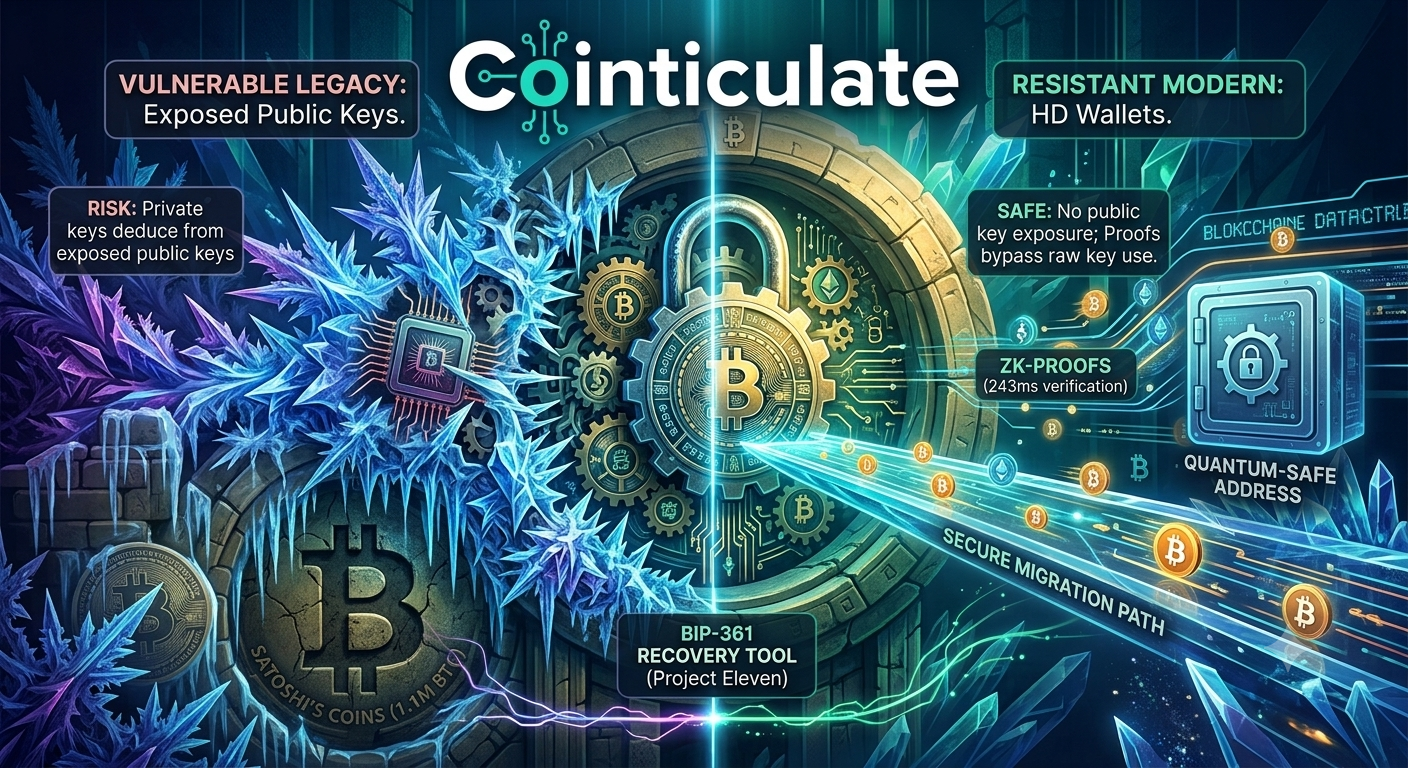
For years, the phrase “Q-Day”—the hypothetical moment a quantum computer becomes powerful enough to crack modern cryptography—has been treated as Bitcoin’s ultimate doomsday scenario. If a quantum entity can reverse-engineer a private key from an exposed public key, roughly one-third of the entire Bitcoin supply could be stolen overnight.
However, a newly unveiled recovery tool has proven that Bitcoin is not defenseless. The catch? The very mechanism designed to save the network will permanently lock out Bitcoin’s creator, Satoshi Nakamoto, sacrificing over 1.1 million coins for the greater good.
The Five-Year Countdown: Understanding BIP-361
To understand the solution, we must first look at the proposal trying to mitigate the threat. A Bitcoin Improvement Proposal known as BIP-361 outlines a strict defense mechanism against quantum attacks.
Under the proposal, any Bitcoin address deemed “quantum-vulnerable” (older addresses where the public key has already been revealed on the blockchain) will face a ticking clock. After three years, these addresses will be blocked from receiving new deposits. After five years, they will be frozen entirely to prevent quantum hackers from draining them.
While this protects the network from catastrophic theft, it creates a massive problem: how do legitimate owners of these dormant or legacy wallets safely claim and migrate their funds once the freeze takes effect?
Enter Zero-Knowledge Proofs: A 243-Millisecond Rescue
Enter Project Eleven. The crypto research group has funded a proof-of-concept recovery tool that acts as a secure escape hatch.
Utilizing zero-knowledge proofs (ZKPs), the tool allows an individual to prove they own a frozen, vulnerable wallet without ever exposing their private key or master seed phrase to the public network. Once ownership is verified via the ZKP, the system automatically constructs a valid transaction to migrate the funds to a modern, quantum-resistant address.
What makes this breakthrough particularly remarkable is its efficiency. Running on standard consumer hardware, the tool can verify a wallet’s history and generate a migration transaction in just 243 milliseconds. It proves that mathematically, Bitcoin can outrun the quantum threat without sacrificing user privacy.
The Trillion-Dollar Catch: Why Satoshi Can’t Be Saved
Despite the technical brilliance of the tool, it contains a glaring, unfixable limitation: it relies entirely on the architecture of modern wallets.
The recovery system works by verifying the “derivation path” of Hierarchical Deterministic (HD) wallets—the standard system introduced around 2012 that generates multiple keys from a single master seed phrase.
Satoshi Nakamoto’s legendary fortune, estimated at roughly 1.1 million BTC, was mined and stored long before HD wallets existed. Satoshi’s coins, along with hundreds of thousands of other early-era Bitcoins, sit in raw, primitive public keys. Because they lack the underlying mathematical structure required by the new ZKP recovery tool, Satoshi’s coins cannot use this escape hatch.
If BIP-361 or a similar soft fork is ever activated, Satoshi Nakamoto’s multi-billion-dollar fortune will be permanently frozen, locked away in a digital tomb to preserve the integrity of the rest of the network.
Cointiculate’s Take: The Price of Survival
This development highlights a harsh reality that the Bitcoin community must eventually face. Surviving the quantum era will not be a seamless transition; it will require a historic sacrifice.
Implementing these defenses requires broad consensus from miners, developers, and node operators to enact a highly contentious soft fork. The community will essentially have to vote to burn the coins of its founding father to ensure the survival of the currency.
The code for the recovery tool is currently unaudited and incomplete, meaning Q-Day is still a distant hurdle. But Project Eleven has proved that when the quantum threat arrives, Bitcoin will have the tools to survive—even if it means leaving its creator behind in the past.
What do you think? Should Bitcoin freeze legacy coins to protect against quantum hackers, even if it means locking out Satoshi? Let us know in the comments below!