
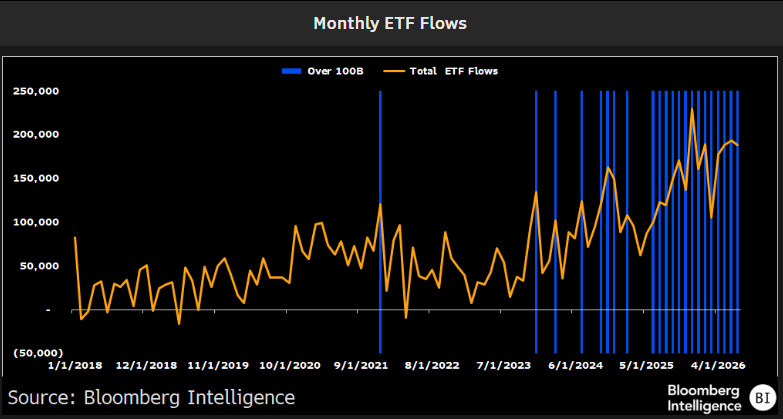
Bloomberg’s Eric Balchunas dropped a number this week that deserves more attention than a passing scroll: U.S.-listed ETFs have now pulled in more than $100 billion in net inflows for 14 consecutive months. Balchunas’s framing was blunt the $100 billion month is becoming the new normal. When the guy who’s tracked ETF flows for two decades starts using the word “normal” for what used to be a blowout month, that’s worth unpacking.
The Scale Nobody’s Fully Priced In
This isn’t a one-quarter fluke. US ETFs pulled in nearly $1.5 trillion in net inflows for the full year 2025, and the first half of 2026 delivered over $1 trillion in net inflows the strongest first-half performance ever recorded for the industry. Individual months have blown past even that torrid pace: February 2026 was a standout, with net inflows landing between $192 billion and $196.7 billion, and April followed with $178 billion, of which $139 billion came from equity products alone. Total industry assets under management have followed suit, hitting a record $14.28 trillion by the end of February 2026.
Equity ETFs particularly those tracking US large caps have been the primary magnet for capital, with fixed-income ETFs contributing a steady, less headline-grabbing stream of inflows throughout the streak.
Where Crypto Fits Into This Machine
Here’s the part Cointiculate readers should care about most. Crypto ETFs have been riding the same structural wave, and the numbers back it up. Bitcoin’s flagship vehicle didn’t just launch into this environment it broke every prior ETF speed record doing it. Bloomberg’s own coverage has tracked BlackRock’s IBIT hitting the $100 billion mark faster than any ETF in history, including Vanguard’s VOO a fund that took years to get there. Balchunas has been explicit about the significance: in roughly two decades of covering this asset class, he’s said he’s never seen anything comparable to Bitcoin ETF adoption speed.
That’s not just a Bitcoin story either. US crypto ETFs as a category have had genuine record months of their own within this broader boom July alone brought in a record haul for the category, with inflows split roughly evenly between Bitcoin and Ethereum products, a sign the appetite isn’t just a single-asset trade.
Why “Normal” Is the Dangerous Word
The uncomfortable truth sitting underneath Balchunas’s comment: markets have a way of forgetting that “normal” flow regimes eventually revert. A structural shift toward passive, algorithm-driven capital allocation means routine volatility increasingly gets absorbed automatically rather than actively priced which is bullish on the way up and can accelerate moves on the way down when the same automated flows reverse. Crypto ETFs, still the newest and most volatile corner of this ecosystem, sit closer to that edge than a large-cap equity fund does. Bitcoin ETFs have already shown they can hold steady through sharp drawdowns without panic selling but that resilience has only been tested in one direction of macro conditions so far, not through a genuine reversal of the $100-billion-a-month tide itself.
Cointiculate’s Read
A $100 billion month becoming boring is a genuinely bullish signal for how deeply ETFs including crypto ETFs have been wired into mainstream portfolio construction. It also means crypto’s price action is now more tethered than ever to a flow regime it doesn’t control. When that tide turns, and eventually it will, the question isn’t whether crypto ETFs get pulled along with it it’s how violently.
Cointiculate Markets Desk