
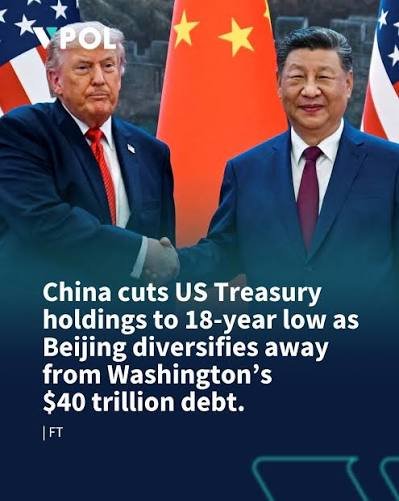
Now this is a story with teeth. Forget crypto for a minute. This is the real power game, and it’s been unfolding in plain sight for years while everyone was busy staring at candlestick charts.
Here are the numbers, and they should stop you in your tracks. China’s holdings of US Treasuries have fallen to $618 billion, the lowest level since August 2008. That’s not a blip. That’s less than half of the $1.3 trillion peak China held back in November 2013. Beijing has been quietly, deliberately, relentlessly walking away from American debt for over a decade, and the retreat accelerated hard after 2022.
And you know exactly what happened in 2022, don’t you? Russia invaded Ukraine, and Washington froze Russian overseas assets almost overnight. That was the moment. That was the wake-up call heard in every finance ministry from Beijing to Riyadh. If the United States can freeze a rival’s assets with the stroke of a pen, what exactly is stopping them doing it to you next time you fall out of favour?
China got the message loud and clear. So did plenty of others.
Now let’s talk about who’s filling the gap, because this is where it gets uncomfortable. Foreign governments are stepping back from US Treasuries across the board. Overall foreign holdings dropped to $9.25 trillion in July, the second consecutive monthly decline. But hedge funds and private investors are buying more. So the composition of who owns America’s debt is quietly shifting from sovereign nations with long time horizons and geopolitical patience, to private capital chasing yield with a trigger finger.
That matters enormously. Governments hold debt for strategic reasons and tend to sit tight. Hedge funds hold debt because the number looks good today, and they’ll dump it the second it doesn’t.
And here’s the bit that should really worry you. Weaker foreign demand is one of the reasons the 30-year Treasury yield has been pushed to nearly a 20-year high, with the 10-year climbing above 5 percent for the first time since 2023. Higher yields sound great if you’re buying bonds. They’re a disaster if you’re the US government trying to borrow money to fund an already enormous deficit. Every basis point higher means billions more in interest payments, year after year, compounding into a bigger problem down the line.
So join the dots with me. Washington and Tokyo had to jointly intervene to prop up the yen this summer, the first such move since 1998. The Treasury announced debt buybacks to try to calm long bond markets. And China, quietly, methodically, is stepping away from the table entirely.
This is not a crash. Nobody is panicking. That’s precisely what makes it so significant. This is a slow, deliberate, multi-year decoupling being executed by the world’s second largest economy, in full public view, and most people still aren’t paying attention because there’s no single dramatic headline to grab them by the collar.
There will be a reckoning eventually. Debt this large doesn’t get more expensive to service forever without consequences. And when your biggest strategic rival has spent a decade quietly reducing its exposure to your currency and your government bonds, that’s not paranoia talking. That’s foresight.
China saw this coming years ago. The question is whether Washington is watching, or whether it’s too busy arguing about the next election cycle to notice its creditors walking out the door.
That’s Cointiculate. Straight talk, no spin.