For years, Bitcoin was dismissed by governments as a speculative asset with little place in the financial system. Today, that narrative is changing.
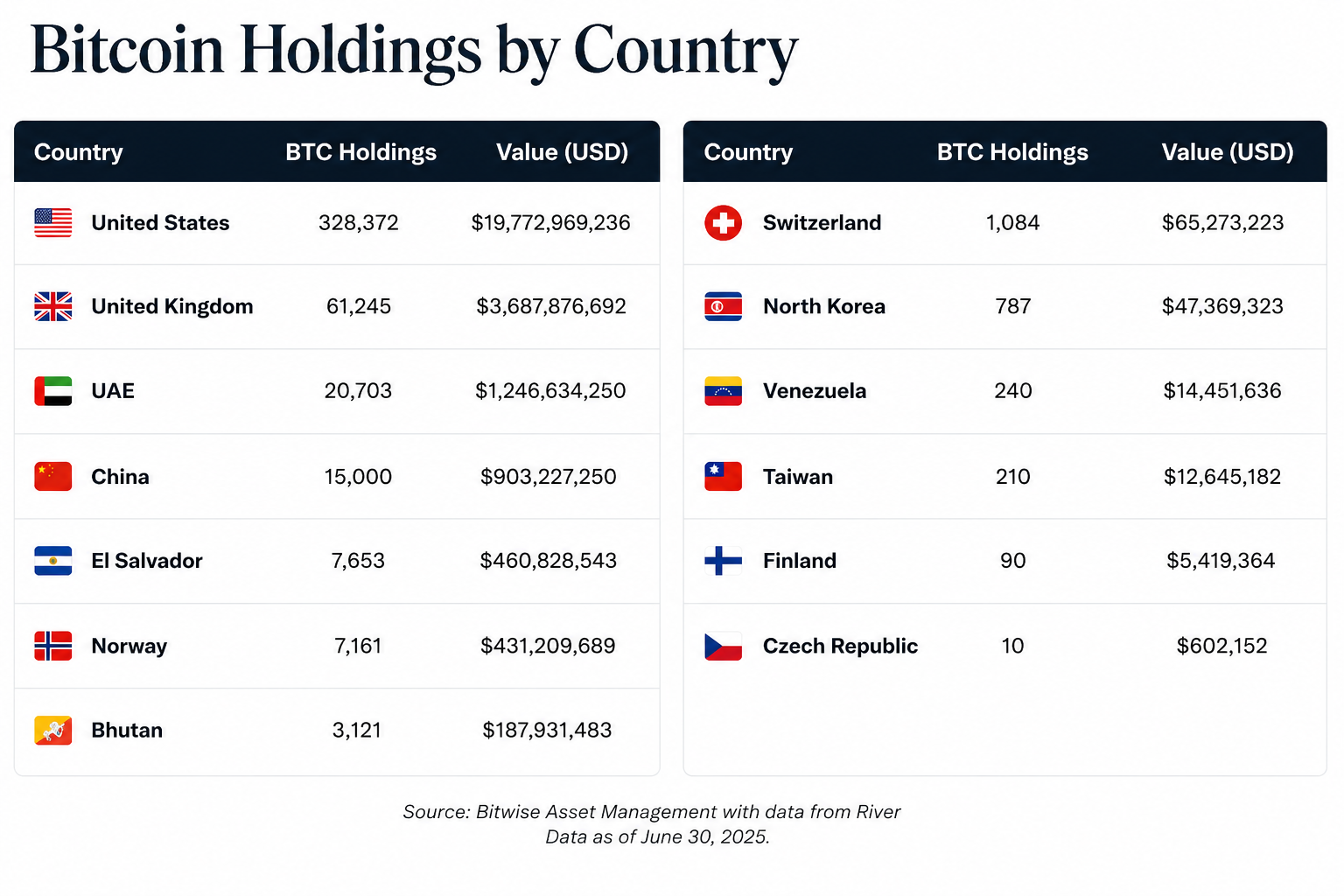
According to data shared by Bitwise, 13 governments now collectively hold approximately $26.8 billion worth of Bitcoin, highlighting how digital assets are becoming increasingly intertwined with national financial strategies.
The United States leads by a considerable margin, holding 328,372 BTC, valued at roughly $19.8 billion. That is nearly three times more than the combined holdings of the other 12 governments on the list.
The United Kingdom ranks second with more than 61,000 BTC, followed by the UAE, China, El Salvador, Norway, Bhutan, Switzerland, North Korea, Venezuela, Taiwan, Finland, and the Czech Republic.
What Does This Suggest?
Government Bitcoin holdings send several important signals about the asset’s evolving role.
Bitcoin Is Becoming a Strategic Asset
Many of these holdings originated from criminal seizures rather than direct purchases. However, an increasing number of governments are choosing to hold rather than immediately liquidate their Bitcoin.
That shift suggests Bitcoin is increasingly being viewed as a strategic financial asset rather than simply confiscated property.
National Competition Could Be Emerging
Countries have spent decades competing to accumulate gold reserves.
If Bitcoin continues maturing into a globally recognized store of value, governments may eventually compete to accumulate digital reserves in much the same way.
Nations that establish meaningful positions early could benefit if Bitcoin appreciates over the coming decades.
Institutional Confidence Continues to Grow
Government ownership adds another layer of legitimacy to Bitcoin’s investment case.
When sovereign states, public companies, pension funds, ETFs, and institutional investors all hold the same asset, it becomes increasingly difficult to argue that Bitcoin exists only on the fringes of finance.
Regulation Is Replacing Resistance
Rather than attempting to eliminate cryptocurrencies, many governments are now focused on regulating them.
Recent regulatory developments across Europe, the United States, the Middle East, and Asia suggest policymakers increasingly expect digital assets to remain part of the global financial system.
Not Necessarily a Bullish Guarantee
Government ownership alone does not guarantee higher prices.
Many countries could decide to sell portions of their holdings to raise revenue or fund public spending. Large government sales have historically created short-term market volatility.
The significance lies less in the holdings themselves and more in the broader trend: governments are no longer treating Bitcoin as something to ignore.
Final Thoughts
The fact that 13 governments collectively hold nearly $27 billion in Bitcoin reflects how far the asset has come since its creation in 2009.
Whether acquired through seizures, mining, or strategic accumulation, these holdings suggest Bitcoin is becoming an increasingly important part of the global financial landscape.
The question may no longer be whether governments will hold Bitcoin—but whether more governments will decide they need it before everyone else does.