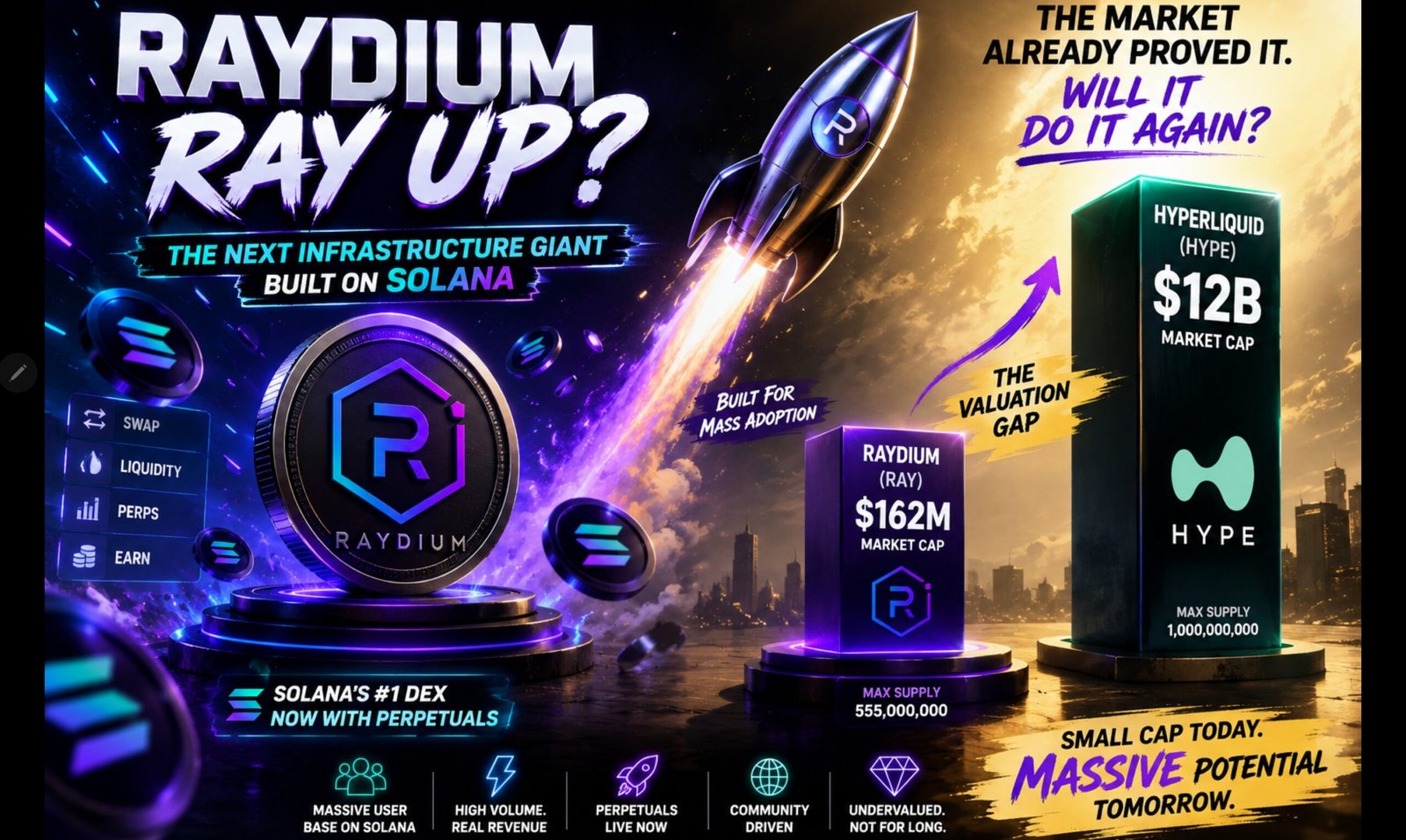
Before Hyperliquid became one of the most talked-about protocols in the industry, it was just another project most investors ignored. Then the market realized something important: exchanges don’t just facilitate trading. They capture value from it.
Now ask yourself another question.
What if the next protocol the market begins to reprice isn’t another perpetual exchange, but the engine powering the world’s busiest blockchain?
That brings us to Raydium.
Raydium isn’t new. It isn’t flashy. It isn’t the latest narrative. But neither was Hyperliquid before institutions, traders, and the wider market suddenly decided its business model deserved a premium.
Today, HYPE commands a valuation that reflects confidence in its ability to monetize trading activity. Yet Raydium sits at the center of Solana’s DeFi ecosystem, processing swaps, providing liquidity, and acting as the launchpad for countless new tokens.
The comparison isn’t perfect. Hyperliquid dominates perpetual futures, while Raydium focuses on spot trading and liquidity infrastructure. They’re different businesses.
But they’re also similar in one crucial respect.
Both are exchanges. Both earn from user activity. Both become more valuable as their ecosystems grow.
Here’s where things become interesting.
Solana has one of the largest and most active user bases in crypto. Millions of users already interact with applications built on the network, and Raydium is one of the biggest beneficiaries of that activity.
If the market starts valuing Raydium with the same enthusiasm it once reserved for Hyperliquid, investors may begin asking why one exchange token commands such a significant premium while another powers one of crypto’s busiest ecosystems.
That doesn’t mean Raydium should trade at Hyperliquid’s valuation.
It does mean the gap deserves scrutiny.
Markets don’t move because something is good.
They move because perceptions change.
Hyperliquid proved that exchange tokens can become some of the market’s biggest winners when investors begin pricing in long-term cash flows, protocol revenue, and network effects. Raydium already has many of those ingredients.
The question isn’t whether Raydium becomes “the next Hyperliquid.”
The question is whether the market has fully appreciated what it already is.
Because if it hasn’t, today’s overlooked infrastructure could become tomorrow’s obvious investment. Hyperliquid showed the market what exchange tokens are capable of. Raydium may simply be waiting for investors to connect the dots.
Disclaimer: This article is an opinion piece and should not be considered financial advice. All cryptocurrencies carry significant risk, and investors should conduct their own research before making investment decisions.
The Valuation Gap Nobody Is Talking About
The market has already shown it’s willing to assign premium valuations to on-chain trading infrastructure.
Hyperliquid proved that.
With a market capitalization of around $12 billion, investors have made it clear they believe decentralized trading platforms can become some of crypto’s most valuable businesses.
Now compare that to Raydium.
Raydium’s market capitalization sits at roughly $162 million barely a fraction of Hyperliquid’s valuation. Yet Raydium has a maximum supply of approximately 555 million tokens, compared to Hyperliquid’s 1 billion. The headline token price is irrelevant. What matters is the valuation the market places on the network.
More importantly, Raydium is no longer just Solana’s leading decentralized exchange. It has expanded into perpetual futureslaunching decentralized perps trading natively on its platformtransforming itself into a broader on-chain trading platform that now competes in one of crypto’s fastest-growing sectors.
This is where the investment thesis becomes compelling.
Hyperliquid demonstrated that the market is willing to reward trading infrastructure with premium valuations. Raydium is building similar capabilities on Solanathe blockchain that consistently attracts one of the largest and most active retail communities in crypto.
Every meme coin launch.
Every token swap.
Every liquidity pool.
Every perpetual trade.
All of it strengthens the ecosystem that Raydium is helping to build.
The question investors should be asking isn’t whether Raydium will become “the next Hyperliquid.”
It’s whether the market is dramatically undervaluing one of the most important pieces of infrastructure on Solana.
No one can say if Raydium will ever reach Hyperliquid’s valuation, and no investment outcome is guaranteed.
But markets don’t need identical outcomes to produce exceptional returns.
If Raydium captures even a small portion of the valuation premium investors have already assigned to leading on-chain trading platforms, today’s valuation could look remarkably different in hindsight.
Sometimes the market doesn’t miss the opportunity.
It simply hasn’t recognized it yet.